
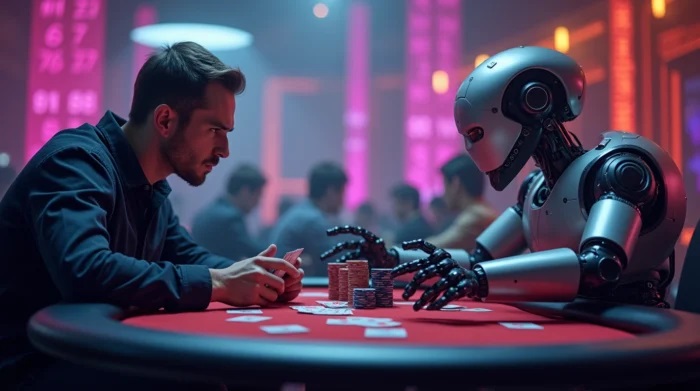
Poker has always been a game of intuition, psychology, and calculated risk. For decades, successful players relied on reading opponents, recognizing patterns, and trusting experience. That balance is now shifting. Artificial intelligence (AI) has entered the poker world and is quietly rewriting the rules, forcing professionals and casual players alike to rethink what “good strategy” really means.
The Rise of AI in Poker
Unlike games such as chess or checkers, poker involves hidden information, randomness, and deception. For a long time, this complexity protected poker from being “solved” by machines. That barrier has fallen.
Modern poker AIs are trained using:
- Game theory optimal (GTO) modeling
- Reinforcement learning through millions of simulated hands
- Advanced probability and decision trees
These systems don’t play like humans. They don’t tilt, guess, or rely on instinct. They calculate relentlessly.
Why Traditional Poker Strategies Are Under Pressure
Many classic poker principles were built on assumptions about human behavior. AI exposes the weaknesses in those assumptions.
Exploitative Play Loses Its Edge
Human players often adjust their play to exploit opponents’ tendencies. AI systems, however:
- Balance their ranges precisely
- Avoid predictable patterns
- Punish over-aggressive exploitation
This makes common tricks like bluff-heavy lines or pressure betting far less effective.
Intuition vs. Mathematics
Experienced players trust their “feel” for the game. AI relies purely on math.
- AI evaluates expected value (EV) in real time
- Marginal decisions are optimized, not guessed
- Small leaks that humans ignore are ruthlessly exploited
Over thousands of hands, these tiny edges become massive.
How AI Redefines Optimal Play
AI doesn’t just copy strong human strategies. It invents new ones that often look wrong at first glance.
Unconventional Betting Patterns
AI frequently:
- Uses unexpected bet sizes
- Mixes bluffs in mathematically balanced ratios
- Calls in spots humans would instinctively fold
What seems reckless is often statistically correct.
Emotionless Decision-Making
Human players struggle with:
- Tilt after bad beats
- Fatigue during long sessions
- Emotional attachment to big hands
AI suffers from none of these. Every decision is treated in isolation, based solely on probability.
The Impact on Professional Players
Top professionals now study AI outputs as part of their training. This has changed how elite poker is played.
Key shifts include:
- Greater focus on range construction
- Less reliance on live reads
- More disciplined bankroll management
Some long-held beliefs—such as always protecting your image or avoiding “weird” lines—are being reconsidered entirely.
Online Poker and the AI Challenge
AI has had its biggest impact online, where data is abundant and speed matters.
Strategy Solvers and Study Tools
Players now use AI-powered solvers to:
- Analyze hand histories
- Discover optimal responses in specific spots
- Identify personal leaks with brutal accuracy
This has raised the overall skill floor, making online games tougher than ever.
Concerns About Fair Play
The same technology used for learning can be abused.
- Unauthorized bots can mimic human behavior
- Detection is an ongoing arms race
- Poker platforms must constantly adapt
The presence of AI forces both players and operators to stay vigilant.
What This Means for the Future of Poker
AI isn’t killing poker—it’s evolving it.
Human creativity still matters, especially in live games where:
- Physical tells exist
- Social dynamics play a role
- Adaptability beats rigid models
The most successful players moving forward will be those who blend human judgment with AI-informed strategy, not those who cling to outdated ideas.
Key Takeaways
- AI exposes flaws in traditional, intuition-based poker strategies
- Game theory optimal play is becoming the new baseline
- Human emotion is both a weakness and a potential edge
- Learning to study AI outputs is now a competitive necessity
Poker remains a battle of minds—but the definition of “smart play” has fundamentally changed.
Frequently Asked Questions (FAQ)
1. Can AI completely solve poker?
No. While AI has mastered many formats, poker’s complexity—especially multi-player games—prevents a full solution.
2. Do professional players still have an edge over AI?
Yes, particularly in live environments where emotional and physical cues matter.
3. Is using AI tools for poker study legal?
Most platforms allow off-table study tools but strictly prohibit real-time assistance during play.
4. How does AI handle bluffing differently than humans?
AI bluffs based on mathematically balanced frequencies rather than gut feeling or table image.
5. Will AI make poker less enjoyable?
For some casual players, games may feel tougher, but for others, deeper strategy makes poker more engaging.
6. Can beginners benefit from AI-based training?
Absolutely. AI tools can accelerate learning by highlighting mistakes early and reinforcing solid fundamentals.
7. Is live poker safer from AI influence than online poker?
Yes. Live poker significantly limits real-time AI assistance, preserving a more human-driven game.
